


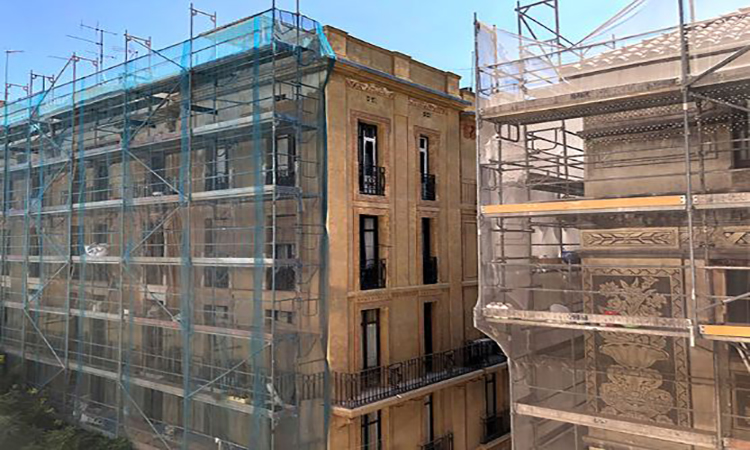
If your building has been accumulating problems for years, such as dampness, deteriorated facades, and cracks that no one wants to inspect closely, you probably already know that postponing the works has a real cost. And if you are in the capital, you will also know that finding a company specializing in vertical works in Madrid that combines technique, safety, and experience is not as simple as it seems. This is where Dalso comes in, a well-established reference in building rehabilitation in Madrid that has been solving problems for years that, for many owners and communities, seemed to have no easy solution.
This article is not a catalog. It is an honest guide on what it involves to rehabilitate a building, what you can expect from the process, and why choosing the right company is, perhaps, the most important decision in the whole project.
Rehabilitating is not just painting the facade
There is a common confusion between rehabilitation and aesthetic refurbishment. Painting the facade can improve the image of the building, yes, but comprehensive rehabilitation goes much further: it involves reviewing the structural condition, intervening on thermal and acoustic insulation, repairing degraded elements, and ensuring that the building complies with current regulations.
In Madrid, many buildings constructed between the 1950s and 1980s present common pathologies: carbonation of concrete, corrosion of reinforcements, leaks in the roof, or loss of sealing in facade joints. Problems that, if not addressed in time, multiply. And so does the cost.
Dalso works with an approach that always begins with diagnosis. Before proposing any solution, its technicians analyze the real condition of the property to design a proportionate intervention, without unnecessary works, but without leaving any area uncovered.
Why vertical works make a difference?
Here is one of the keys that many communities do not consider when comparing budgets: not all companies have the technical capacity to work at height with the same efficiency and safety.
Vertical works, also known as high altitude works or rope access works, allow intervention on facades, roofs, and exterior elements without the need for large scaffolding. This translates into:
- Less impact on public roads: no need to cut streets or occupy sidewalks for weeks.
- Cost reduction: avoiding conventional scaffolding significantly reduces the overall budget.
- Faster execution: teams have direct access to the work area without assembly and disassembly times.
- Access to complicated areas: cornices, interior courtyards, unique elements that would be difficult to reach with scaffolding.
Dalso has certified professionals in rope access techniques, which allows them to undertake works that other companies simply cannot do, or would do with a much more costly logistics.
What a complete rehabilitation includes
When we talk about comprehensive rehabilitation, the scope can vary greatly depending on the building’s condition. In general terms, the most common works managed by Dalso include repairing and sanitizing facades, waterproofing roofs and terraces, structural reinforcement in damaged elements, application of external thermal insulation systems (ETICS), and restoration of stone or mortar elements.
But beyond the list of services, what distinguishes a good rehabilitation company is coordination. Having a single point of contact for the community of owners, meeting deadlines, using the agreed materials, and having no surprises in the final result. That, which seems basic, is not always guaranteed.
The regulatory factor: ITE, CTE, and available aids
Rehabilitating a building in Madrid is not just an aesthetic or maintenance issue. Regulations require it. The Technical Building Inspection (ITE) is mandatory for buildings over 30 years old, and its findings may require corrective works within specific deadlines. Ignoring them has legal and economic consequences.
In addition, the Technical Building Code (CTE) establishes energy efficiency requirements that are increasingly demanding. A well-planned rehabilitation can be an opportunity to improve the building’s energy rating and, in turn, access subsidies from the Recovery Plan or regional aids that cover a significant part of the investment.
Dalso also advises its clients on this point, identifying which aids are compatible with the project and how to process them correctly.
When is the time to act
The short answer: before the problem forces you. Pathologies in facades and roofs do not disappear on their own. They worsen with rains, temperature cycles, and the passage of time. Every year that a necessary intervention is delayed is, almost always, a higher cost in the future.
If your community has been discussing the matter for a while, if there are technical reports on the table, or simply if the facade can’t take it anymore, the best time to contact Dalso is now. Not to sign anything, but to understand what the building has, what it needs, and what is the smartest way to address it.
That is, in the end, what a serious company does: help you make informed decisions. And in rehabilitation, that is worth a lot.