


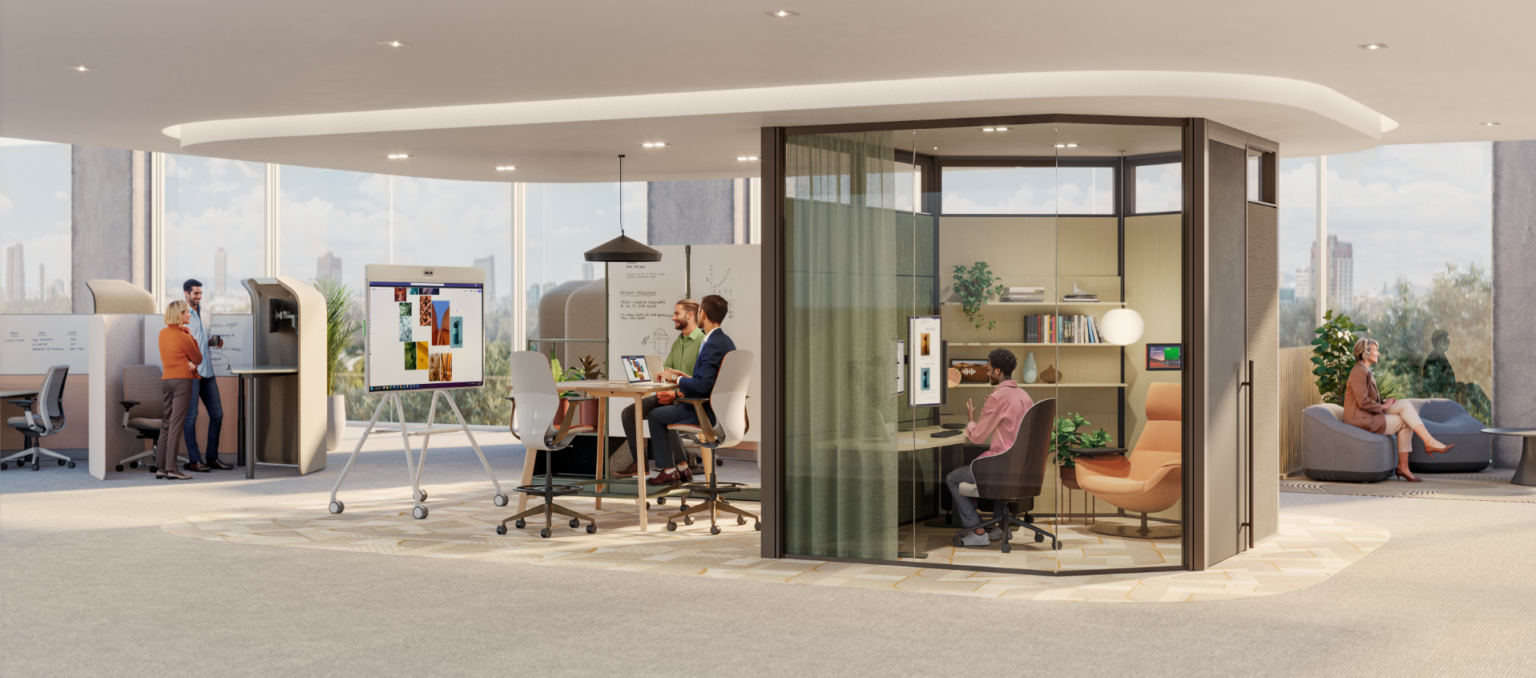
A new study by workplace consultancy Steelcase has revealed how factors such as hybrid work, artificial intelligence, and employee experience are redefining the traditional concept of the office. According to the study, 96% of companies have plans to implement significant changes in their offices in the next two years. After a period of uncertainty, organizations are establishing new guidelines on how they want their workspaces to be, prioritizing the well-being of their employees and flexibility.
The study, based on a survey of 500 executives, details various transformations that will affect the design and use of offices. With hybrid work becoming more common, it is observed that nearly 70% of employees plan to attend the office at least three days a week, while close to half will be present in person full time. This dynamic has led companies to rethink the use of space, favoring versatile environments that allow for both concentration and collaboration.
In addition, the irregular flow of employees throughout the week is driving the adoption of more efficient models that allow for adjusting work capacity without over-sizing the office. Regarding the integration of artificial intelligence, offices are evolving to incorporate this technology seamlessly, including areas designed for the use of AI assistants and optimized acoustics for voice systems. However, it has also been identified that heavy use of these tools can increase cognitive load, prompting the creation of spaces that allow employees to disconnect from digital overstimulation and mentally recover.
The office has become a strategic element in attracting and retaining talent. Nowadays, it is not only designed to accommodate workstations, but to offer experiences that add value to employees and improve their performance. According to Steelcase, 70% of executives plan to move to higher-quality facilities, seeking environments that promote attendance at the office.
In this new work landscape, collaboration, creativity, and human connection are gaining relevance as key benefits that in-person work can provide compared to telecommuting. Offices are conceived as dynamic ecosystems, organized into zones that facilitate various activities, from individual work to learning and rest. At the same time, sustainability and inclusion are presented as priorities in this redesign.
The findings of this research indicate a paradigm shift in the perception of the workspace, where the office transforms from a static place into a strategic tool that promotes both employee well-being and business success.
Source: MiMub in Spanish